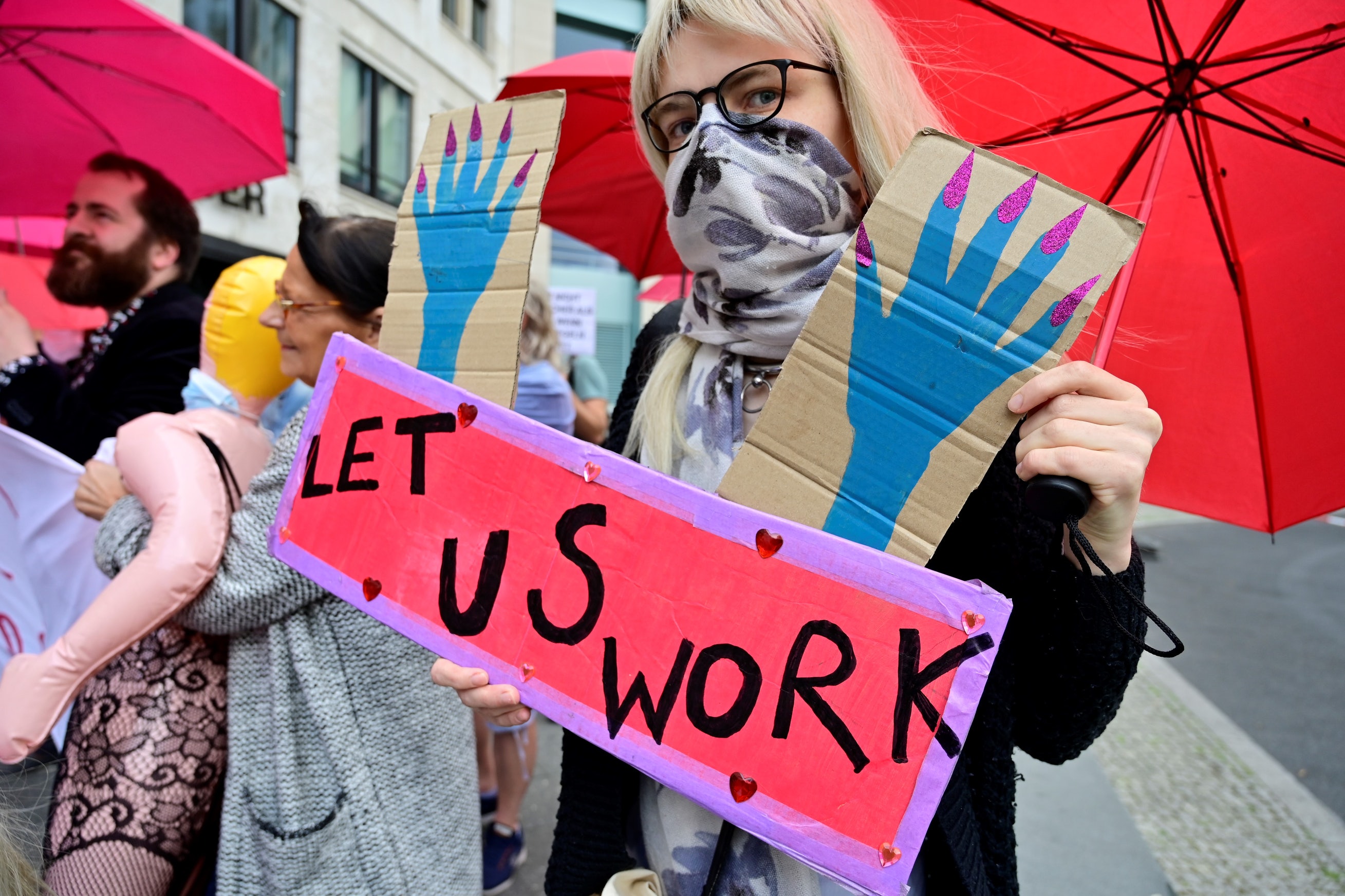
Defining the issues around sex work and the correct policy and societal response is a complex subject. In this regard it is important to closely examine some of the key ideas about sex work and why contextual legislation matters. This case study will look at the current policy and discussion on the subject of decriminalising sex work in the UK and the societal narrative around it. It will achieve this by looking at its impact on sex workers, and their communities, and how this reflects changing norms and values within modern society through a range of sociological sources and approaches. A trigger document, “Examining the impact of prostitution- specific criminal records on women seeking to exit prostitution.” (nia, 2017) was utilised as an up to date overview of the UK’s legislative position and its current impact on sex workers seeking to exit sex work. The terminology used in this case study, ‘sex work/sex worker’, is not used to create conflict or take a particular ideological or moral position but rather used as a general term as discussed in a recent report on sex work by the University of Bristol (Centre for Gender and Violence Research, 2019).
Current UK Legislation leaves sex workers caught in limbo between legalisation and criminalisation. Technically, sex work is legal but “Women in prostitution may be criminalised in a number of ways: for offenses generally and for prostitution-specific offenses.” (nia, 2017, p.16). The nia report highlights four barriers that this criminalisation creates when exiting sex work; fines, Anti-Social Behaviour Orders, custodial sentences and community-based alternatives. The authors frame and argue the case that fines in particular lead to an entrenchment in sex work, the Criminal Justice System, and an exacerbation of pre-existing vulnerabilities all causing barriers to exit (nia, 2017, p.36). The impact of these legislative tools include; hindrances to employment and training when DBS (disclosure and barring service) checks are requested by potential employers (nia, 2017, p.21) or through stigma and discrimination. “Shame and stigma post-exit are reinforced by the permanence of criminal records (Månsson and Hedin, 1999)” (nia, 2017, p.22). The reinforcement of this stigmatisation occurs through the negative association societally attributed to the word ‘prostitution’ as deviant and transgressive from current norms within society. Those negative associations are often internalised by sex workers who choose to exit and those who remain. This itself can lead to performativity of this stigmatisation by accepting the label and it’s negative characterisations as part of their identity, as discussed by Becker through the interactionist approach to deviance (formerly ‘labelling theory’). (Becker, H.S., 2018, p.193-194). This extends to the perception of sex workers by wider society, and the local communities they frequent, as an indication of wider criminality or indicative of the break down of social order. In her book Prostitution In The Community: Sarah Kingston talks about seeing prostitutes through ‘Broken Windows Theory’ as communities see sex workers as an indication of local crime (Kingston, 2014). Bernard Cohen discusses the consequences of applying this theory to policing sex work saying, “broken windows theory does not take into account socially constructed myths that persist about prostitution, nor the realities that counter them.” (Cohen, B., 2019, p.526). The idea that sex work is inherently deviant and transgressive clearly affects legislative, community and policing practice resulting in a detrimental impact on the lives of sex workers and their ability to exit.
In fact, this deviance can have an amplified impact when it is attributed to women. In her book, ‘Doubly Deviant, Doubly Damned’, Ann Lloyd (1995) states that women inherently break a second law when committing a crime, “the much more fundamental law ‘natural’ law, which says women are passive carers, not active aggressors, and by nature morally better than the male of the species. Such a woman is doubly deviant.” (Lloyd, A., 1995, p.36). This common sense approach of the ‘natural woman’ and their socially constructed gender role means those who deviate from this standard are stigmatised within society, reducing them “in our minds from a whole and usual person to a tainted discounted one.” (Goffman, E., 1963, p.12). Schur (1984) echoes this concept of double deviance as he highlights the “dichotomization of women into two classes- the ‘bad women’ with whom men can enjoy this greater freedom, and the ‘good women’ whose reputability is maintained.” This shows an almost utilitarian approach by society as the desire to preserve the virtue of the many ‘naturally good women’ is assured by sacrificing a few ‘bad women’ to the ‘naturally masculine’ sexual appetite. However the social stigma previously exclusive to women in sex work is now used to label and ostracise trans sex workers or men who engage in a traditionally, although ‘illicit’, cis-female role possibly making them even more transgressive than their counter parts. Judith Butler discusses the way we discourage straying outside these performative roles, perpetuating a binary focused society by saying, “The regulation of gender has always been part of the work of heterosexist normativity.” (Butler, 2004, P.186). In this way it is important to note that sex work itself is intimately entwined with our societal narrative of gender, ownership of the body and how we should or should not be allowed to use it.
There has been a shift in the way that issues relating to the body and ownership of, in particular, the female personal space are legislated and discussed in our current collective conscious. This shift could be related to the change from transgressive acts being viewed as a necessary evil to being affirmatively valued as an individuals choice (Lucas, p.50). An example of this can be found in both the legislation of abortion rights recently in Northern Ireland and in the #MeToo movement across the media industry and general work environment. In particular #MeToo showcases the fractious perspectives on sexual exploitation and its relationship to a woman’s chosen profession of work. By linking sexual exploitation to problematic discourses on women being ‘unrapeable’ or not really harassed, due to their work itself being linked to sex acts, the colour of their skin, or disabilities, we see the imperative need to acknowledge this misogynistic narrative pervasive in our work and home environments. (Hess, 2018; Moore, 2018; North, 2018.) The importance of looking at current discourses on sexual exploitation and sexual violence and how they contribute to our norms, values and beliefs cannot be overstated. In their book Revolting Prostitutes Juno Mac & Molly Smith (2018) highlight the importance of understanding the difference between approaching sex as a symbol and sex as work, they go on to discuss viewing sex work through labour-centred analysis in order to facilitate harm minimisation and reduce the objectification that comes with sexual symbology (Mac & Smith, 2018, p.11-13). The idea of two distinct approaches sheds light on the impact of discussing sex as a symbol and reinforcing victimizing language in relation to sex work. Discussing Focault on the relationship between power and freedom Alison Phipps writes, “His work poses a key question: in protesting against women’s oppression, can we potentially produce the sexual difference we seek to eliminate (Scott, 1996)?” (Phipps, 2019, p.3). However it should be noted that sex work itself is inherently gendered with the majority of workers identifying as female, a statistic that results in the obvious question of why? This could be due to multiple factors: a socially constructed, and sanctioned, view of the action of sex (and therefore sexuality) as binary and the current social narrative tied to the feminine and masculine; or another form of subjugation forced on women by an inherently androcratic structure. Regardless of the approach we take when discussing sexual violence and its relationship to sex work or a sex-related job, it is important to understand what shapes our perspectives. Undeniably the exposure to violence and exploitation that a transgressive non-normative job or status within society affords cannot be ignored and requires an intersectional (Crenshaw, 1991) approach looking at the often stigmatised layers of socially constructed classifications that result in these jobs being deemed deviant.
This case study agrees with the trigger document (nia, 2017) that the focus on punitive measures rather than rehabilitative by the government leads to a perpetuating cycle of criminalized behavior and counter measures. This desire for a punitive legislative response rather than rehabilitative is influenced by the societal narrative of double deviance towards women for their transgressive sexual behavior and the rejection by communities fearful of a causative rather than correlative relationship between sex work and the increase of criminal behavior in the local environment. The lack of societal support that leads to sex workers being labeled as deviant is only further entrenched by criminalising consentual actions related to their work due to a collective idea that this type of sex is inherently deviant and dangerous to the community. As Ann Lucas points out, “The public and the legislatures view prostitution as being primarily about sex- sex outside the confines of marriage, deviant sex, sex without the intent to reproduce, paid sex.” (Lucas, 1995, p.48) It is equally important to remain mindful of the exploitation of vulnerable members of society through trafficking, social inequalities and abusive coercion within sex work. Perhaps it is not possible to divorce an individual’s body and their freedom of choice from the idea that to purchase something is to claim ownership and power. However in a currently violent and abusive profession, throughout the period of employment and after, legislation must be shaped that mitigates violence and reshapes our harmful social narrative whilst protecting the rights of individuals to determine what they can and cannot do with their bodies.
References:
Becker, H.S. (2018) Outsiders: Studies in the Sociology of Deviance. Free Press ed. New York: Free Press An Imprint of Simon & Schuster, Inc.
Butler, J. (1988) ‘Performative Acts and Gender Constitution: An Essay in Phenomenology and Feminist Theory’, Theatre Journal, 40(4), pp. 519-531. Available at: The Johns Hopkins University Press Stable URL: http://www.jstor.org/stable/3207893
Centre for Gender and Violence Research (2019) The nature and prevalence of prostitution and sex work in England and Wales today [online]. Bristol: University of Bristol. Available from: https://assets.publishing.service.gov.uk/government/uploads/system/uploads/attachment_data/file/842920/Prostitution_and_Sex_Work_Report.pdf [Accessed 18 November 2019].
Cohen, B. (2019) Police Enforcement of Prostitution as a Quality-of-Life Offense: New York City, United States, and Frakfurt am Main, Germany. Deviant Behaviour [online]. 40(5), pp. 526-534. [Accessed November 18, 2019]. Available from: https://www.tandfonline.com/doi/full/10.1080/01639625.2018.1431096
Crenshaw, K. (1991) Mapping the Margins: Intersectionality, Identity Politics, and Violence against Women of Color. Stanford Law Review [online]. 43(6), pp. 1241-1299. [Accessed November 21, 2019]. Available from: https://www.jstor.org/stable/1229039?
Goffman, E. (1963) Stigma, Notes on the Management of Spoiled Identity. 3rd ed. New Jersey: Penguin Books.
Hess, S.F. (2018) The Stain of Slavery is Silencing Sexual Violence Against Black and Brown Women. Nursing Clio[online] 17 April. Available from: https://nursingclio.org/2018/04/17/the-stain-of-slavery-is-silencing-sexual-violence-against-black-and-brown-women/ [Accessed 22 November 2019].
Kingston, S. (2014) Prostitution in the Community: Attitudes, Action and Resistance. 1st ed. London: Routledge.
Lloyd, A. (1995) Doubly Deviant, Doubly Damned: Society’s Treatment of Violent Women. New York: Penguin Books.
Lucas, A.M. (1995) Race, Class, Gender and Deviancy: The Criminalization of Prostitution. Berkley Women’s Law Journal [online]. 10, pp. 47-60. [Accessed November 18, 2019]. Available from: https://heinonline.org/HOL/Page?collection=journals&handle=hein.journals/berkwolj10&id=55&men_tab=srchresults
Mac, J. & Smith, M. (2018) Revolting ProstitutesThe Fight For Sex Workers’ Rights. London: Verso.
Moore, S. (2018) Rape: why isn’t justice being done? The Guardian[online] 22 October. Available from: https://www.theguardian.com/society/2018/oct/22/rape-why-isnt-justice-being-done [Accessed 22 November 2019].
nia (2017) ‘I’m no criminal’ : Examining the impact of prostitution-specific records on women seeking to exit prostitution: 2017. London: nia.
North, A. (2018) The Asia Argento allegations reveal our damaging misconceptions about sexual assault survivors. VOX [online] 21 August. Available from: https://www.vox.com/identities/2018/8/21/17760222/asia-argento-jimmy-bennett-sexual-assault-me-too [Accessed 22 November 2019].
Phipps, A. (2019) ‘Every Woman knows a Weinstein’: political whiteness and white woundedness in #MeToo and public feminisms around sexual violence. Feminist Formations [online]. 31(2), pp. 1-25. (Accepted) [Accessed November 18, 2019]. Available from: http://sro.sussex.ac.uk/id/eprint/83531/3/Phipps%20Every%20Woman%20Knows%20a%20Weinstein.pdf
Schur, E.M. (1984) Labeling Women Deviant: Gender, Stigma and Social Control. Philadelphia: Temple University Press.
First Year undergrad

 Thought and or reflections