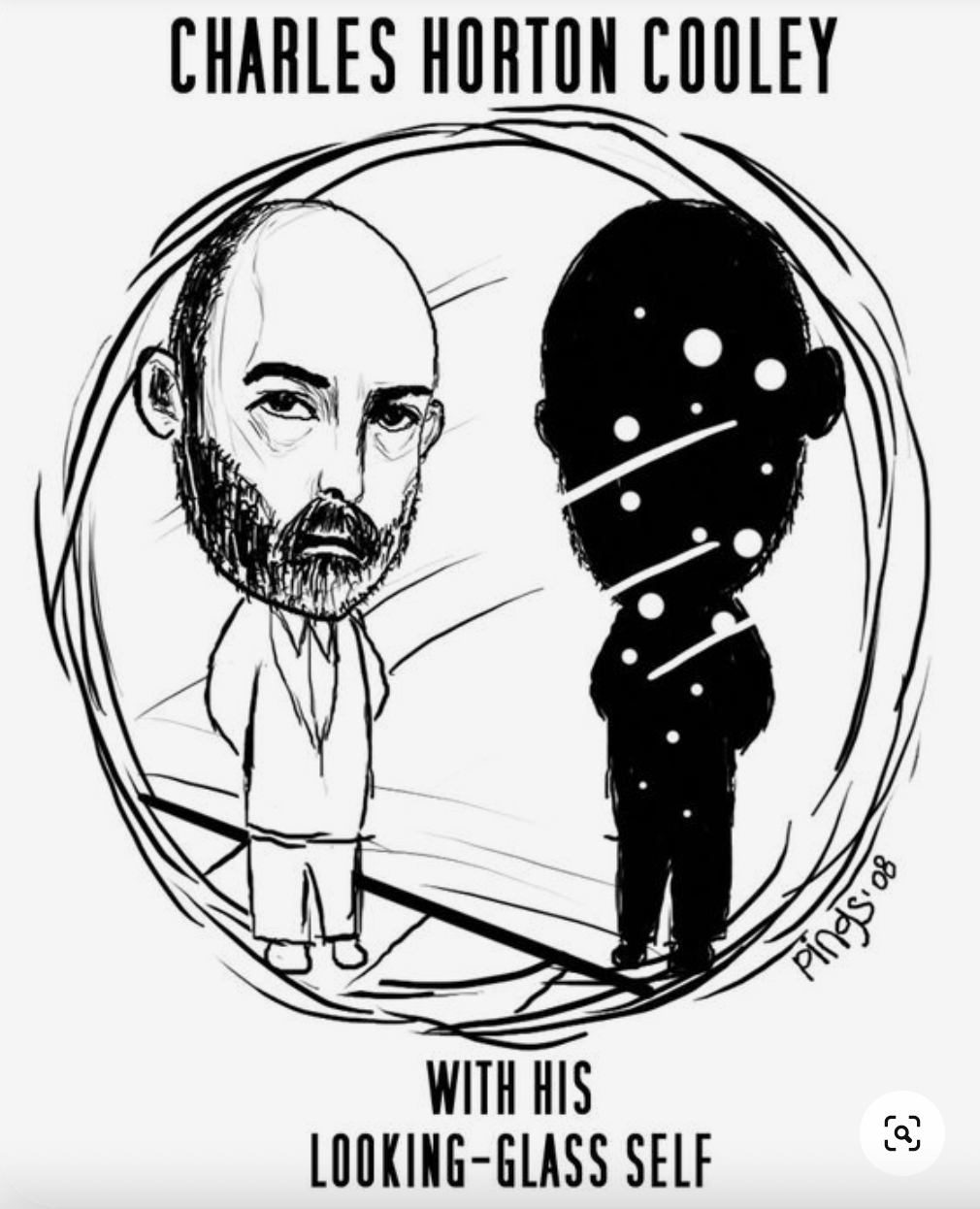
Symbolic interactionism is a micro-perspective approach to society specifically dealing with the individual and their interactions with other individuals or groups. Herbert Blumer, utilising foundational ideas laid out by George H. Mead, coined the term symbolic interactionism and looked at individual interactions and the transitory nature of meaning. Mead lays out three key steps for generation of the ‘self’ or the system of beliefs that hold an individual together as an identity. Namely, action depends on meaning, different people assign different meanings to things, and that the meaning itself can change (G.H.Mead, 1972). Charles Cooley elaborates on this exploration of the ‘self’ viewing individuals as inherently social with their understandings of ‘I’ and ‘me’ being linked to the concept of “self-feeling” (Cooley, 1922, pp.172-175). They go on to elaborate on the power dynamic displayed in an individuals ownership of actions, “The social self is simply any idea, or system of ideas, drawn from the communicative life, that the mind cherishes as it’s own.” (Cooley, 1922, p.179). The entwined identity of the self and the social is set in “three principal elements”: the self imagines how others see it, the self imagines how others judge it, and finally the self acts according to the emotional response or self-feeling elicited by the initial stages (Cooley, 1922, p.184). It should be noted that Mead critiqued Cooley’s concept of ‘self-feeling’ believing it to be, “a conception of society that is mental rather than scientific.” (Mead, 1930, p.706).
This elasticity of self and fixation on the importance of self-feeling can be seen in Goffman’s work on the individual in social interactions. In an article discussing Goffman’s relationship to Cooley’s concept of the Looking-Glass Self Thomas Scheff (2005) notes that Goffman elaborates on the three steps found in the original concept to include the management of emotion. He attributes this to, “Goffman’s exploration of impression management.” (Scheff, 2005, p.159). In an earlier article Scheff (2000) notes the lack of definition given to the emotions highlighted by both Cooley and Goffman suggesting that it is essential to acknowledge that some are ‘social emotions’. In particular shame, and several emotions that fall under its banner including embarrassment, shyness, and humiliation, stating, “What unites all these cognates is that they involve the feeling of a threat to a social bond.” (Scheff, 2000, p.97). This threat to the social bond between individuals and therefore society is essential in the production of our behaviour and therefore our concept of self.
For example through the medium of Youtube we have an expansion of community and the dynamics that accompany them, as well as several newer social dynamics, but all are held captive by the management of emotions resulting in a modified and modern development of self. In an article entitled ‘Youtubers are not your friends’ The Verge (2018) cites Wohl and Hortons work (Horton & Wohl, 2016) on para-social interactions and how it could relate to the modern phenomenon of Youtubers’ relationships with their viewers. However, I believe that the dynamic between the two is more than para-social and in fact indicative of, and beholden to, the management of emotions on both sides. Multiple interviews with Youtubers reveal an adaptation of self, a curation of internal thought-life based on the idea of how they are perceived by viewers. (Engadget, 2018; Top Universities, 2017). ) A sociological touchstone for this is Hochschilds work on the commercialisation of emotion and its impact not just on the production of self but also the social interactions with others. “In interpreting a smile, we try to take out what social engineering put in, pocketing what was only meant for us.” (Hochschild, 2012, p.34). This is particularly interesting when examining the impacts of “Forced Positivity on Youtube” (Pewdiepie, 2017; Berryman & Kavka, 2018) and the strengthening of social bonds due to self-exposure and vulnerability rather than the perceived inevitability of loss of social bonds. It brings into question the applicability of the concept of self, as utilised by Scheff, Goffman, and Cooley, being created due to fear of the breaking of social bonds. Perhaps it requires an addendum that the creation of self may have another element, a rectification of any miscalculation when evaluating others apparent beliefs about the self.
References:
Alvarez, E. (2018) Mental Health and the relentless Youtuber Life. engadget [online] 12 July. [Accessed 21 April 2020]
Berryman, R.; Kavka, M. (2018) Crying on Youtube: Vlogs, self-exposure and the productivity of negative effect. Convergence: The International Journal of Research into New Media Technologies[online]. 24(1). pp. 85-98. [Accessed April 21, 2020]. Available from: https://journals.sagepub.com/doi/full/10.1177/1354856517736981
Collier, S. (2017) How Becoming a YouTuber Changed My Life. TOPUNIVERSITIES[online] 15 August. [Accessed 21 April 2020]
Available from: https://www.topuniversities.com/blog/how-becoming-youtuber-changed-my-life
Cooley, C.H. (1922) Human Nature and the Social Order. [Online]. Charles Scribner’s Sons. [Accessed April 21, 2020]. Available from: http://scholar.google.co.uk/scholar_url?url=https://ttu-ir.tdl.org/ttu-ir/bitstream/handle/2346/47107/ttu_stc001_000010.pdf%3Fsequence%3D1&hl=en&sa=X&scisig=AAGBfm2UQqUEqiXFeDEoCg91gCmTz3U1Cw&nossl=1&oi=scholarr
Farokhmanesh, M. (2018) Youtubers are not your friends. engadget [online] 17 September. [Accessed 21 April 2020]
Available from: https://www.theverge.com/2018/9/17/17832948/youtube-youtubers-influencer-creator-fans-subscribers-friends-celebrities
Hochschild, A.R. (2012) The Managed Heart: Commercialization of Human Feeling. [Online]. 3rd Edition. California: University of California Press. [Accessed April 21, 2020]. Available from: https://www.dawsonera.com/readonline/9780520951853
Horton, D.; Wohl, R.R. (1956) Mass Communication and Para-Social Interaction. Psychiatry>Interpersonal and Biological Processes[online]. 19(3). pp. 215-229. [Accessed April 21, 2020]. Available from: https://www.tandfonline.com/doi/abs/10.1080/00332747.1956.11023049
Mead, G.H. (1930) Cooley’s Contribution to American Social Thought. American Journal of Sociology [online]. XXXV. pp. 693-706. [Accessed April 21, 2020]. Available from: https://brocku.ca/MeadProject/Mead/pubs2/papers/Mead_1930a.html
Mead, G.H. (1972) Mind, Self, and Society. Eighteenth Edition. Chicago: The University of Chicago Press.
PewDiePie (2017) Forced Positivity on Youtube. Youtube. 06 Jan. Available from: https://www.youtube.com/watch?v=iyGI1uHyyws
Scheff, T.J. (2000) Shame and the Social Bond: A Sociological Theory. Sociological Theory[online]. 18(1). pp. 84-99. [Accessed April 21, 2020]. Available from: https://onlinelibrary.wiley.com/doi/abs/10.1111/0735-2751.00089
Scheff, T.J. (2005) Looking-Glass Self: Goffman as Symbolic Interactionist. Symbolic Interaction[online]. 28(2). pp. 147-166. [Accessed April 21, 2020]. Available from: https://doi.org/10.1525/si.2005.28.2.147
First Year Undergrad

 Thought and or reflections