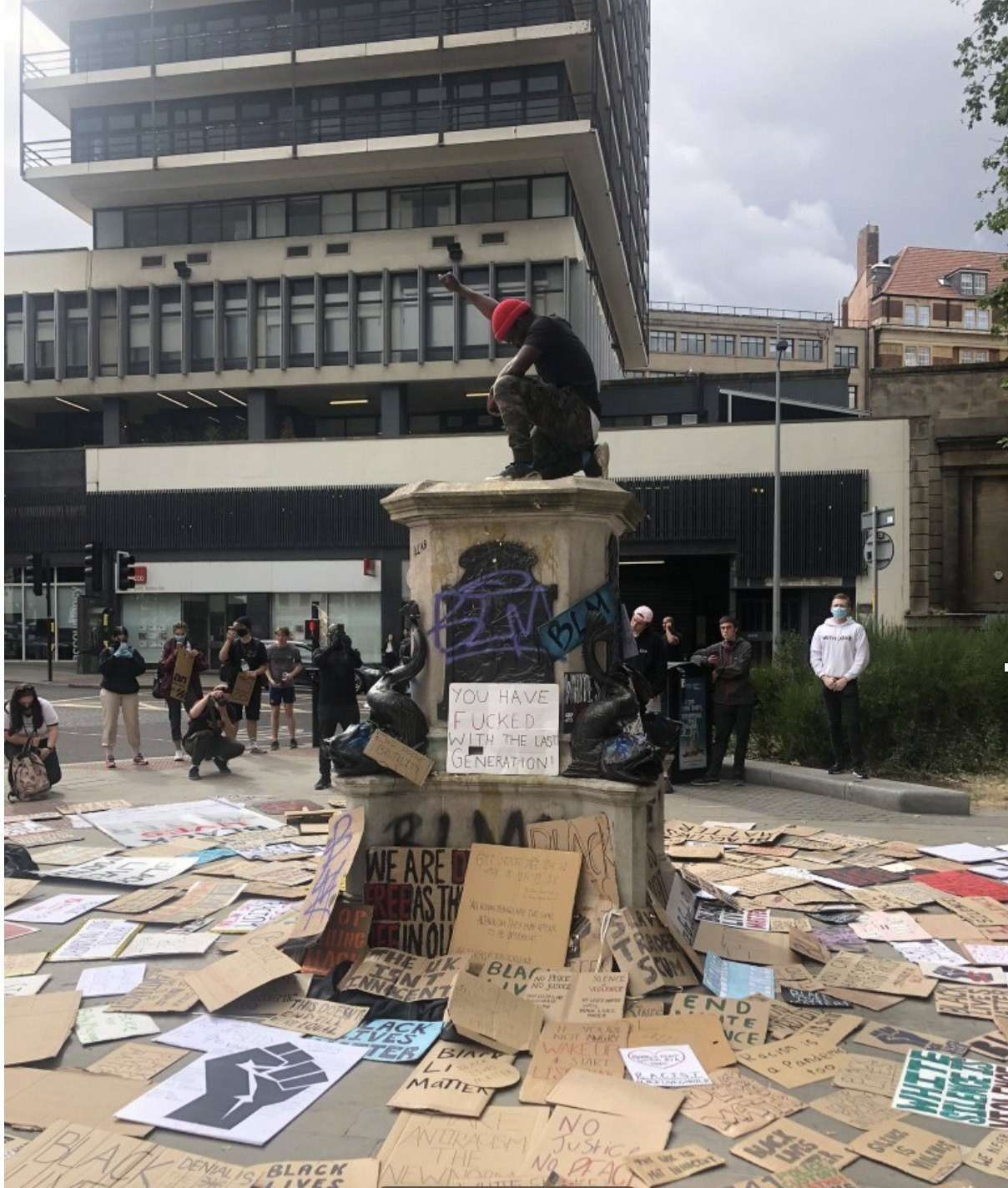
On June 7th, 2020, as part of the Black Lives Matter Protests (BLM), the statue of Edward Colston was pulled down and thrown into the Avon river in the City of Bristol. The powerful imagery of this statue being pulled down by Bristol residents made headlines around the world re-igniting discussions on, some for and some very much against, the removal of statues or historic monuments due to their clear connection to horrific acts of racism such as slavery and imperialism. The historical roots of imagery cannot be ignored as a statue itself is much more than a simple stone monument, it is a piece of art and to understand what an artist or, in the case of statues, commissioners were saying a larger context must be understood.
Do statues really matter?
Statues have long played a significant role in human history for several reasons, they are a place for us to gather, remember and educate each other. They hold a unique ability to memorialise momentous and sometimes horrifying human events as well as individuals and their historic behaviour. Statues go further than a photo or documentary. It is an agreed upon moment that we, as a community or elected officials, seek to recognise and reflect on. The powerful artistic statement of raising an image above us has been around for thousands of years whether it is the first known Venus carved into existence 35,000-40,000 years ago, towering statues depicting great Pharaohs of ancient Egypt, or Napoleonic columns in Trafalgar square. But it is not possible to guarantee objectivity or harmony when erecting or evaluating a memorial or statue. Simon John ascribes this to the fact that, “they are symbolic of the fixed ideas of a specific community regarding its past, as captured at a particular point in time.” While an important window to the past they cannot be taken at face value, contextual viewing is essential to divining the meaning behind them.
The Colston statue and its history
The Colston statue is a prime example of how statues represent far more than what is readily apparent upon a superficial viewing. For example, if we examine the history of who placed it there, when it was placed, and the events around the Colston name, at that point in history, we find that the name had become almost independent from the historical figure. A carefully crafted mythology was being implemented by Bristolean merchants 170 years after Colston had died. Rhetoric about a ‘father of the city’ and ideas of why he mattered seem to be a curated set of ideology and mythos, “Colston was being reinvented in the Victorian period to represent the economic, social and political perspectives of the Bristol business elite.”. One of the key features highlighted on the statue is his philanthropic efforts where he is seen dispensing charity to poor children. However, when critically examined Colston societies that claimed to be carrying on in his tradition gave minimally to charities with their combined charitable donations making up 1.5 percent of the total cost of relieving the poor for the year of 1884. When examining the Colston statue within the context of the BLM protests it is crucial to discuss what was largely undiscussed until the 1990’s. During the dedication of the statue the Mayor of Bristol dedicated one veiled sentence to the most significant element of Colston’s life, “His business was mainly in the west indies” (Bristol Mercury, November 14, 1895). What exactly was the nature of this business? Empire and commerce through the bodies of slaves, an estimated 20,000 men, women, and children. It is important to emphasise that Colston was not a disinterested investor but had a proactive roll across the RAC (Royal African Company) with a position on all three of their committees and establishing a fourth, “the committee for buying goods.”.

Photo Credit: BBC, Dave Betts.
Bigger than a single statue
When taking a further contextual step back academics point to a more considered and intentional picture of statue placement around the same period as the Colston Statue. Peter Hill focuses on 36 statues all challenged or pulled down in relation to the BLM protests and points out that over half of them, including Colston, were erected between 1889-1919. Why is this period so important? Hill cites two key instances that held sway at this point, the implementation of Jim Crow laws in the US and a “high noon of formal Imperialism”. By highlighting this connection between the majority of these statues to this section of history we can see a distinct connection to ‘race’ and imperialism. In fact, not simply imperialism but rather ‘New Imperialism’.
New Imperialism (1870-1940) needed public buy-in to shore up the average British subjects view of the empire- it, “demanded a public emotional investment in the imperial project”. This could consist of buying imperial imports like coffee, tobacco, and chocolate to consuming publications discussing the virtues of the empire and what it sells and how it is, for example, “lightening the white man’s burden… teaching the virtues of cleanliness.”. This perspective towards its export of civilization to the more ‘savage’ aspects of the colonies is a clear example of Social Darwinism. By examining this wider context we can begin to look at the statue of Colston and the timing of its placement as a dedication to these ‘new imperial’ values. Perhaps, as seen by the proactive group of commissioners at that time, a figure who can become the embodiment for this New Imperialism in the City of Bristol?
So where does that leave us?
When examining the Colston statue through the ‘new imperial’ lens it goes much further than being the statue of a slave trader but becomes a consolidated and intentional implementation of imperial values. These statues are monuments to archaic ideas around whiteness and its mythologised ‘inherent’ civility and superiority. They are monuments installed with, what Said described as a, “high handed executive attitude” combined with a “relationship of power, domination, of varying degrees of a complex hegemony”. The entwined relationship of new imperialism, ‘race’, and propaganda with statues erected during this time cannot be ignored. We must be honest with ourselves and admit the context, that not only embodies these statues, but also created them.
References:
Ball, R. (2017) Edward Colston Research Paper #2. Bristol Radical History Group [blog]. 17 July. Available from: https://www.brh.org.uk/site/articles/edward-colston-research-paper-2/ [Accessed 25 Jan 2021].
Ball, R. (2018) Myths Within Myths. Bristol Radical History Group [blog]. 14 October. Available from: https://www.brh.org.uk/site/articles/myths-within-myths/?fbclid=IwAR37MvfOc_p4RFiWTMbH_uqpbGZZKkN_aqatd8c31SqYGZ474jgNeLMkJFk [Accessed 25 Jan 2021].
BBC (2020) Edward Colston statue: Four charged with criminal damage. Available from: https://www.bbc.co.uk/news/uk-england-bristol-55248263 [Accessed 25 Jan 2021].
Conrad, N.J. (2009) A female figure from the basal Aurignacian of Hohle Fels Cave in southwestern Germany. Nature [online]. 459, pp. 248-252. [Accessed 25 Jan 2021].
Francis, P. (2013) Everyday Imperialism: The Landscape of Empire, London, 1870-1939. PhD, Rice University.
Hill, P. (2020) When the Statues Went Up. History Workshop [online] 12 June. Available from: https://www.historyworkshop.org.uk/when-the-statues-went-up/ [Accessed 25 Jan 2021].
Historic England (1977) Statue of Edward Colston [online]. Available from: https://historicengland.org.uk/listing/the-list/list-entry/1202137 [Accessed 25 Jan 2021].
John, S. (2019) Statues, Politics, and The Past. History Today [online] 9 September. Available from: https://www.historytoday.com/archive/behind-times/statues-politics-and-past %5BAccessed 25 Jan 2021%5D.
McClintock, A. (1993) Soft-soaping empire: commodity racism and imperial advertising. In: Bird, J. et al, eds. (2005) Travellers’ Tales: Narratives of Home and Displacement [online]. London: Routledge, pp. 128-152. [Accessed 11 August 2010].
Said, E.W. (1978) Orientalism 3rd ed. London: Penguin Books.
The History of Parliament (2002) COLSTON Edward II (1636-1721), of Mortlake, Surr. Available from: http://www.historyofparliamentonline.org/volume/1690-1715/member/colston-edward-ii-1636-1721 [Accessed 25 Jan 2021].
Unknown. (1895) The Colston Statue. Unveiled By the Mayor. Bristol Mercury [online] 14 November. Available from: https://www1.britishnewspaperarchive.co.uk/viewer/bl/0000035/18951114/022/0005 [Accessed 25 Jan 2021].
Second Year Undergrad

 Thought and or reflections